What is the likelihood we may discover an exoplanet that could sustain human life? And are scientists searching for non-human life on other worlds? Find out more about the science behind the search for...
If you have ever used manual camera controls to photograph in low light, you know that the darker it is, the longer the exposure needs to be. Keeping the camera shutter open longer allows more light to...
How do we learn so much about what exoplanet are like? Can astronomers today actually detect water on distant worlds? Find out more about the science behind the search for a habitable exoplanet in the...
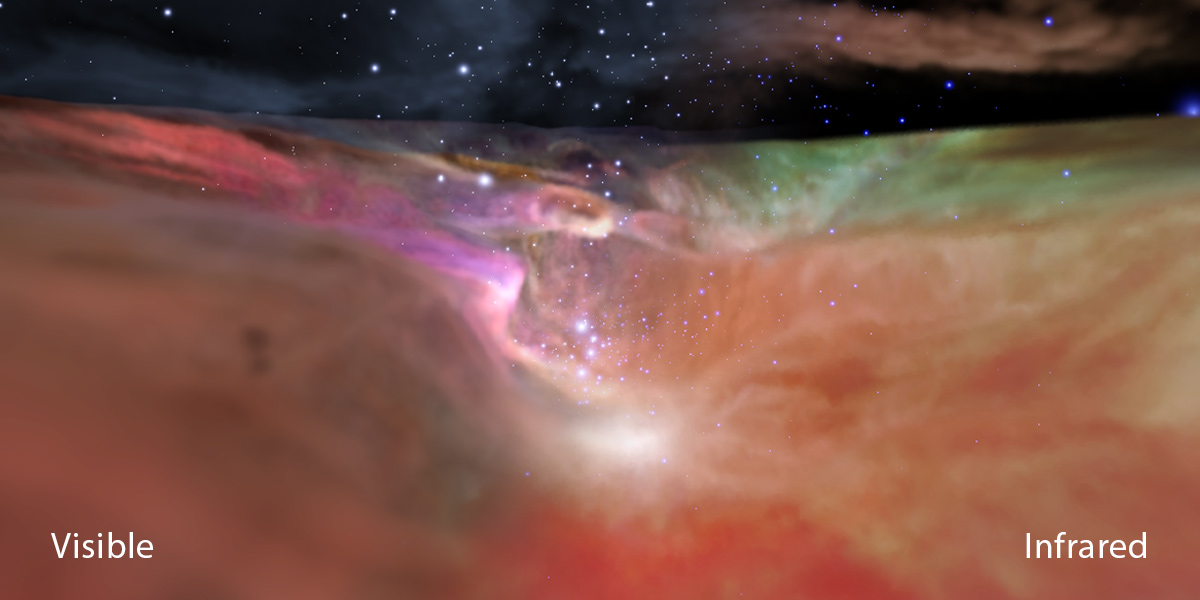
This visualization explores the Orion Nebula using both visible and infrared light. The sequence begins with a wide-field view of the sky showing the plane of our Milky Way Galaxy, then zooms down to the...
How are real scientific data used to help visualize exoplanets? What decisions do visual artists have to make when depicting an exoplanet? How do exoplanet researchers feel about exoplanet art? Find out...
How can an exoplanet be at the right temperature but still not have liquid water? If we want to find an exoplanet that could host life like us, why does it matter what that planet is made of? Find out...
Get set for launch! Eyes on Exoplanets will fly you to any planet you wish – as long as it's far beyond our Solar System. This fully rendered 3D universe is scientifically accurate, allowing...
Human eyes have evolved to detect the rainbow of colors that make up visible light – but it is only one form of light. There are other types of electromagnetic radiation that human eyes cannot see....
Visions of the Universe: Four Centuries of Discovery portrays our changing views of the universe through time with images and text. The exhibit includes 12 panels that feature key astronomical discoveries...
NASA's Chandra X-ray Observatory uses binary code to gather information about Earth's surface. That code, in the form of two numbers (1s and 0s), is then read and converted by computers into images....
Researchers have detected thousands of planets orbiting stars other than the Sun. The data show that these planets are even more varied than the planets and moons in our solar system. They range from small...
Scientists have detected thousands of exoplanets: planets orbiting stars other than the Sun. We have seen only a few exoplanets directly, but we can detect them by measuring the effects they have on the...
Welcome to a new "one-stop shopping" experience that makes finding the right astronomy image easier than ever!
AstroPix offers publicly accessible image galleries of many of the leading astronomical...
Where do stars come from? A science expert (Jerrika Hinton) explains by hooking her hapless assistant (Wil Wheaton) up to a Thought Visualizer, a machine that allows anyone to see his thoughts. With Ed...
Not all stars shine consistently! Some stars temporarily increase in brightness for several days or weeks, while others have periodic changes in brightness. In other examples, stars change in brightness...