
EDUCATIONAL RESOURCES AND EVENTS

Educational Resources and Events Catalog

Filter Resources

(117 total)

Filter Results

  1. Cosmic Pitch

    Activities | Poster | Resource Guide
    Whether it’s a ball rocketing toward the net or a star shooting across the cosmos, both soccer and space are full of motion, energy, and force. Cosmic Pitch connects the world’s most popular...
    Thumbnail with the words 'COSMIC PITCH' in white text, where the 'O' is a soccer ball, set against a starry nebula background in green, red, and blue hues, with a burst of light rays radiating from behind the soccer ball.
  2. Science Briefing: New Insights into Rocky Exoplanets with the James Webb Space Telescope

    December 4, 2025 Professional Learning Webinar

    In this final edition of NASA’s Universe of Learning Science Briefings, we will explore how the James Webb Space Telescope is revolutionizing our understanding of rocky planets around stars other ...

  3. Science Briefing: The Shocking Universe

    October 2, 2025 Professional Learning Webinar

    In this edition of NASA’s Universe of Learning Science Briefings, we will explore cosmic shocks — regions where fast-moving particles crash into slower material, triggering sudden changes in ...

  4. Science Briefing: Andromeda Galaxy

    August 7, 2025 Professional Learning Webinar

    In this edition of NASA’s Universe of Learning Science Briefings, we will learn about the formation and evolution of our nearest large neighbor galaxy, the Andromeda Galaxy. The clues to its formation ...

  5. Paint a Star-forming Nebula

    Activities
    In this activity, participants explore real telescope images of star-forming nebulae and create watercolor paintings to visualize how stars, gas, and dust interact in these dynamic regions. A step-by-step...
    A person’s hand holds a paintbrush and is adding finishing touches to a watercolor painting of a star-forming nebula. The scene is viewed from above, with the paper placed on a wooden table. The nebula painting shows towering, reddish-brown pillar-like formations resembling those found in deep space images, surrounded by a soft, swirling purple and blue sky filled with stars. Bright yellow and orange star shapes, along with small scattered black and blue dots, depict stars scattered across the cosmic scene. On the left side of the image, a watercolor palette features over 30 vibrant colors, including shades of pink, orange, blue, green, and brown. A few colors show signs of recent use, with drops of paint on the palette and paper.
  6. Exploring the Cosmic Cliffs in 3D

    Videos
    This visualization presents a flight through the ethereal landscape of NASA’s James Webb Space Telescope’s famous image nicknamed “Cosmic Cliffs.” These cliffs are a spectacular...
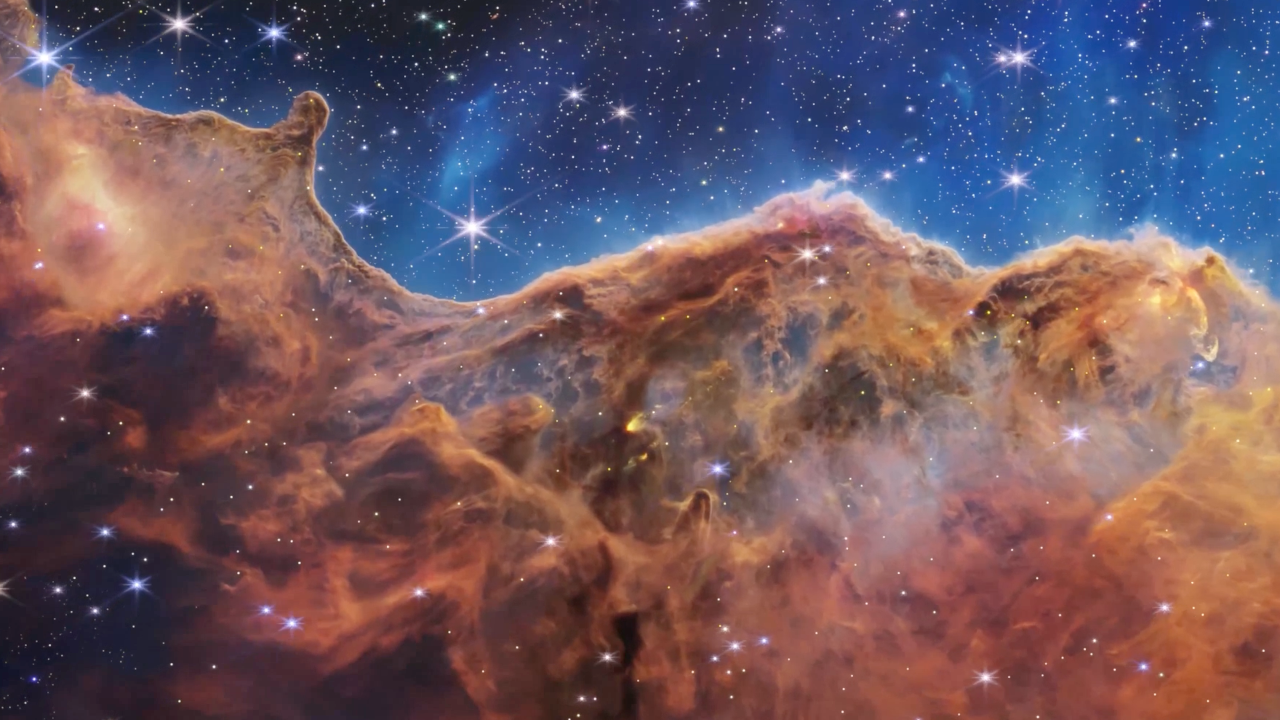
    The image is divided horizontally by an undulating line between a brown cloudscape forming a nebula along the bottom and a comparatively clear upper portion in blue. Speckled across both portions is a starfield, showing innumerable stars of many sizes. The upper blue portion has wispy translucent cloud-like streaks rising from the nebula below. The orange and brown cloudy formation in the bottom half varies in density and ranges from translucent to opaque. The nebula contains ridges, peaks, and valleys—an appearance similar to a mountain range. In the bottom left corner, a clearer area free of gas and dust appears black with speckled stars.
  7. Star Formation from the Carina Nebula to the Cosmic Cliffs

    Videos
    This scientific visualization traverses the vast star-forming region of the Carina Nebula Complex using multiwavelength data from NASA space telescopes. The narrated journey explores clusters of massive...
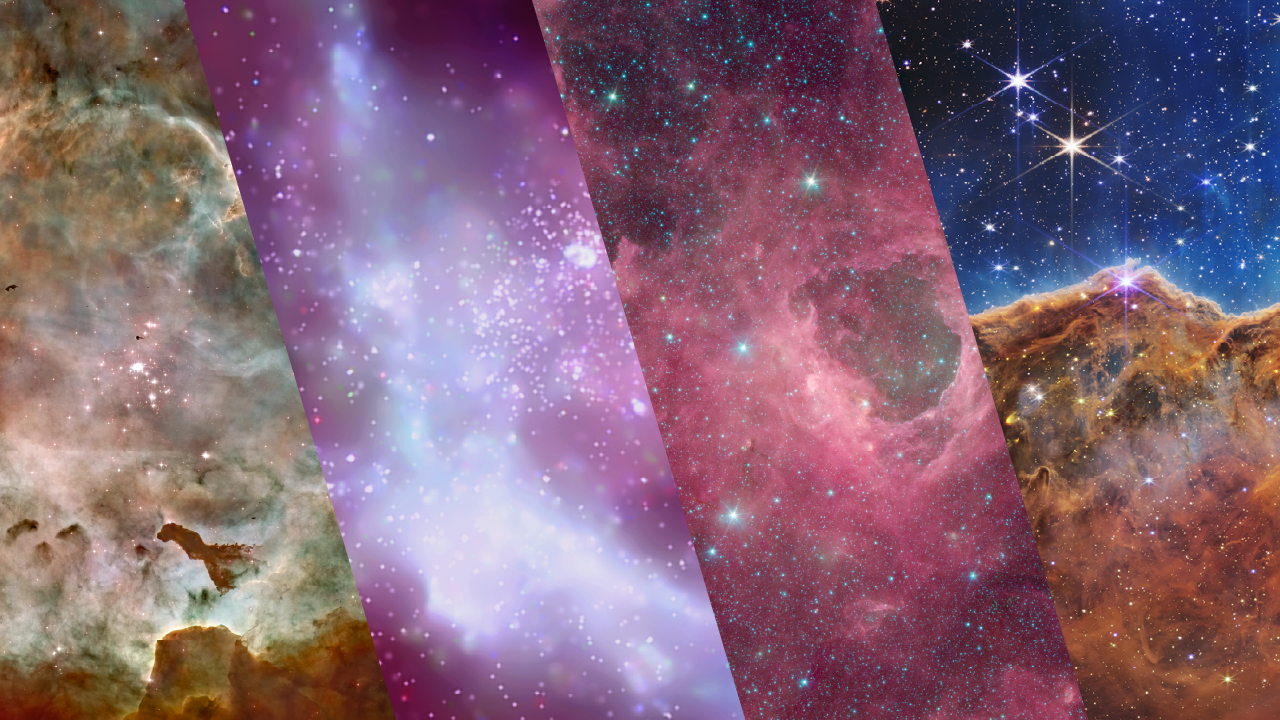
    Four images from the Carina Nebula Complex are spliced vertically at an angle. From left to right: Hubble’s view in brown, gray, and light blue tones with a brilliant white star cluster at center; a bright purple and pink observation by Chandra; a bright pink wash with tiny blue orbs imaged by Spitzer; and a Webb view showing bright blue at top with brown clouds at bottom, overlaid with stars.
  8. Flight to the Carina Nebula Complex

    Videos
    This visualization travels across interstellar space to the vast star-forming region of the Carina Nebula Complex. Starting with the 2D sky as seen from Earth, the sequence traces out the nearby constellations...
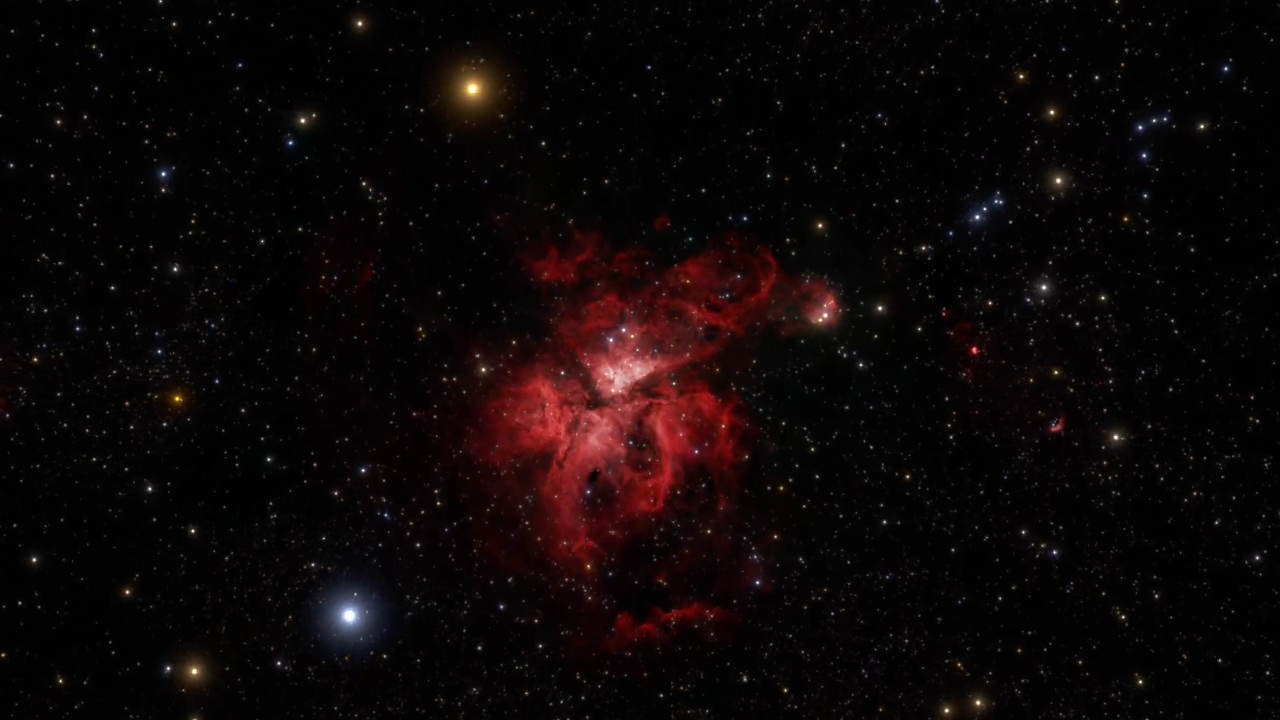
    At the center is a loose splotch of red, the Carina Nebula, set against the black background of space. Distant stars and galaxies are speckled across the scene. The very center of the Carina Nebula is brightest, almost white, with larger stars represented as dots. The gas and dust that make up the nebula take the loose form of flower petals, like an iris. The top “petal” appears in the rough shape of a lowercase V and becomes more diffuse and darker red the farther away the material is from the core. Off to its right is a small, loose red circle with several bright white stars within it. The lower petal of the nebula is also deep red, appearing more like a triangle with one peak centered at the bottom. That edge peters out into deeper red and becomes more translucent the lower it goes. Below that, a short horizontal line of deep semi-transparent red material appears. There is a prominent orange orb center-left at the top, and a blue one toward the bottom a little farther left.
  9. Science Briefing: Cosmic Wrecks

    May 1, 2025 Professional Learning Webinar

    In this edition of NASA’s Universe of Learning Science Briefings, we will learn about the largest-scale collisions in the universe. These collisions take place at the scales of comets/asteroids and ...

  10. Science Briefing: The Dynamic Universe - From Exoplanets to Stars and Black Holes

    March 6, 2025 Professional Learning Webinar

    In this edition of NASA’s Universe of Learning Science Briefings, we will learn about objects in the universe whose brightness appear to change over time and what we can learn from them. Dr. Jennifer ...

  11. Science Briefing: Live from AAS! 2025

    January 16, 2025 Professional Learning Webinar

    Please join us for this special edition of the NASA’s Universe of Learning Science Briefings! We will be live at the American Astronomical Society meeting in National Harbor, Maryland, where scientists ...

  12. Science Briefing: Up: Astrophysics with High-Altitude Balloons

    December 5, 2024 Professional Learning Webinar

    In this edition of NASA’s Universe of Learning Science Briefings we will learn how high-altitude scientific balloons help us expand our picture of the universe. Dr. Erika Hamden will talk about ...

  13. Program Guide & Resources: Stars

    Resource Guide
    Stars are giant balls of gas held together by their own gravity. They have different colors and sizes, and like humans, they have a life cycle: Stars are born, grow old, and eventually die.  With...
    Rectangular graphic illustrating the Stars program theme. The right four-fifths of the graphic consists of an infrared image of the Pillars of Creation from the Webb Space Telescope. The pillars are a ghostly blue-gray color with craggy finger-like tips. Running vertically along the left side of the image is a wide pink bar. In the lower half of the bar is a line drawing of a simple hand-held telescope on a tripod. The telescope points toward a circular field of view showing stylized stars with four-pointed diffraction patterns.
  14. Program Guide & Resources: Data and Imaging Processing

    Resource Guide
    Scientists rely on computers not only to do calculations, but also to transform telescope data into images. Coding and programming are some of the many methods that astronomers use in order to study the...
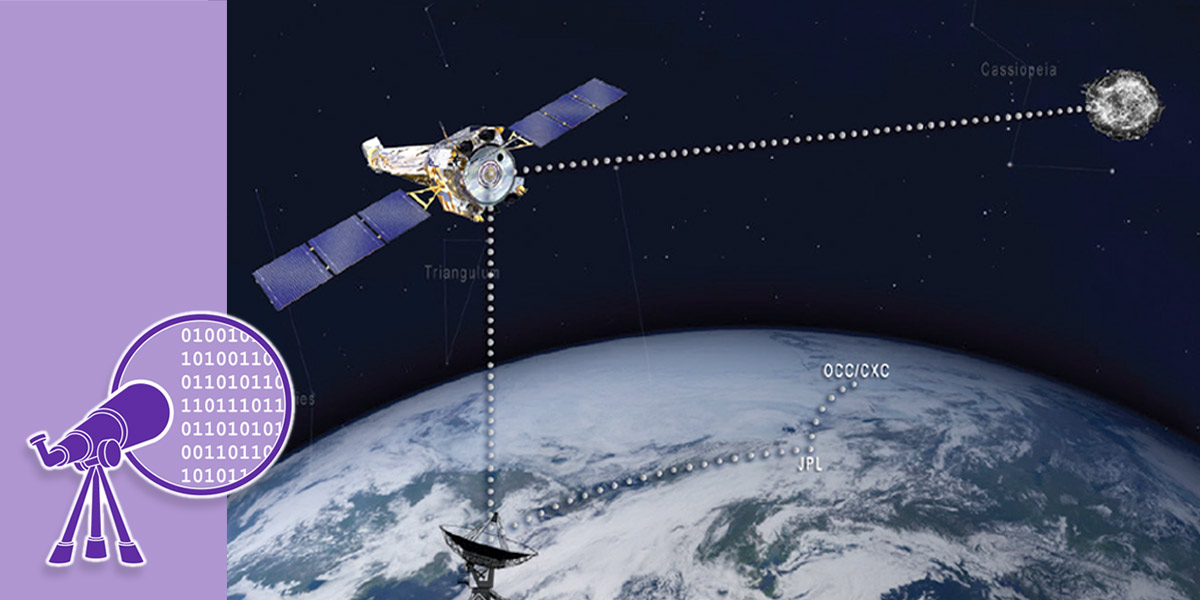
    Rectangular graphic illustrating the Data and Image Processing program theme. The right four-fifths of the graphic shows a space telescope orbiting Earth, collecting data from a supernova remnant, and transmitting the data to a large satellite dish.    Running vertically along the left side of the image is a wide purple bar. In the lower half of the bar is a line drawing of a simple hand-held telescope on a tripod. The telescope points toward a circular field of view showing rows of ones and zeros.
  15. Program Guide & Resources: Electromagnetic Spectrum

    Resource Guide
    Astronomers learn about space objects by gathering and analyzing the light coming from them. Since there is more than one type light, observations of multiple types of light from an object —multiwavelength...
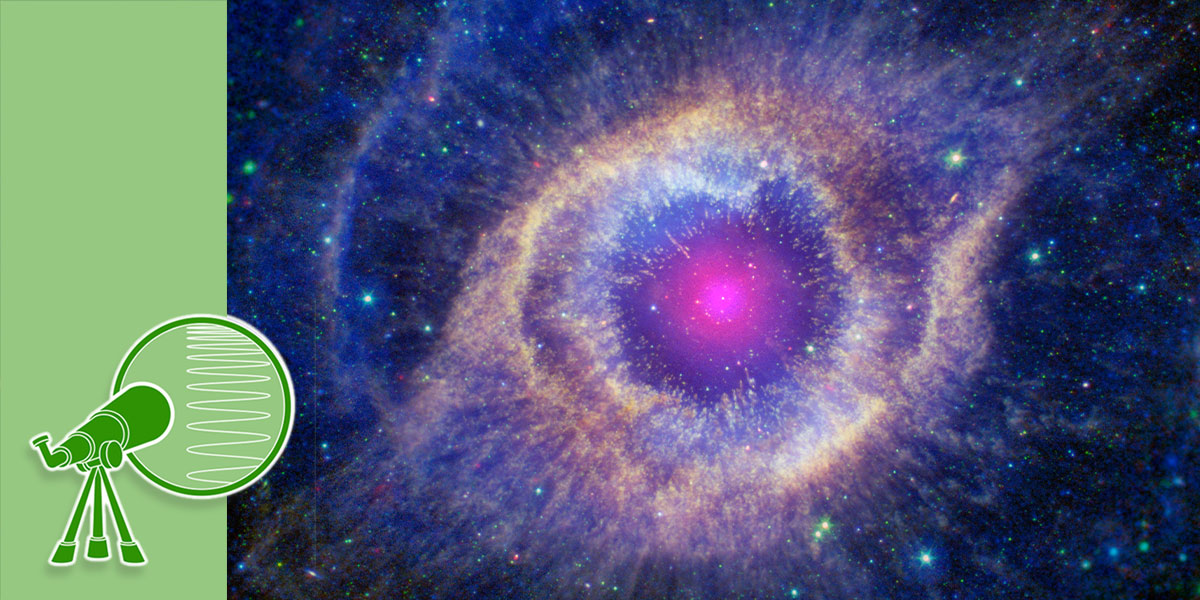
    Rectangular graphic illustrating the Electromagnetic Spectrum program theme. The right four-fifths of the graphic is a colorful multiwavelength space telescope image of a planetary nebula. The nebula looks like a human eyeball, with a hot pink pupil surrounded by blue and orange iris-like rings.   Running vertically along the left side of the image is a wide green bar. In the lower half of the bar is a line drawing of a simple hand-held telescope on a tripod. The telescope points toward a circular field of view showing an expanding wave pattern.